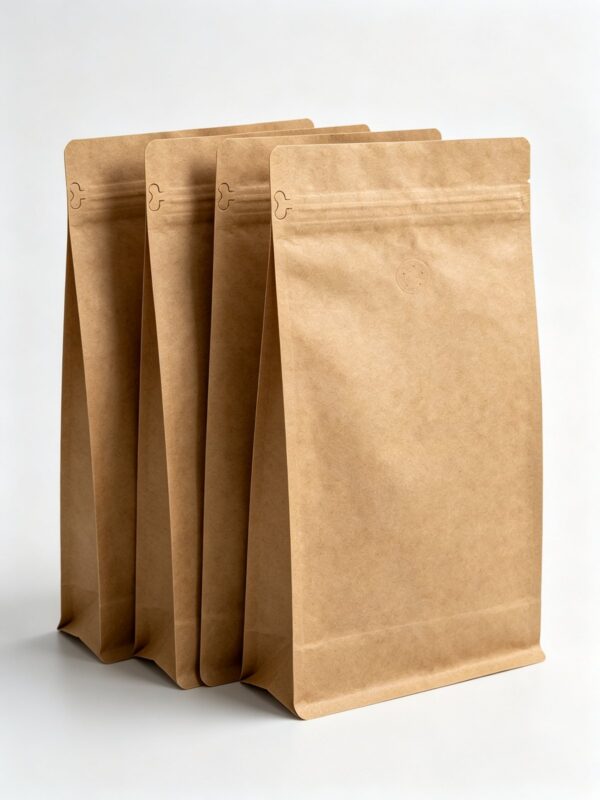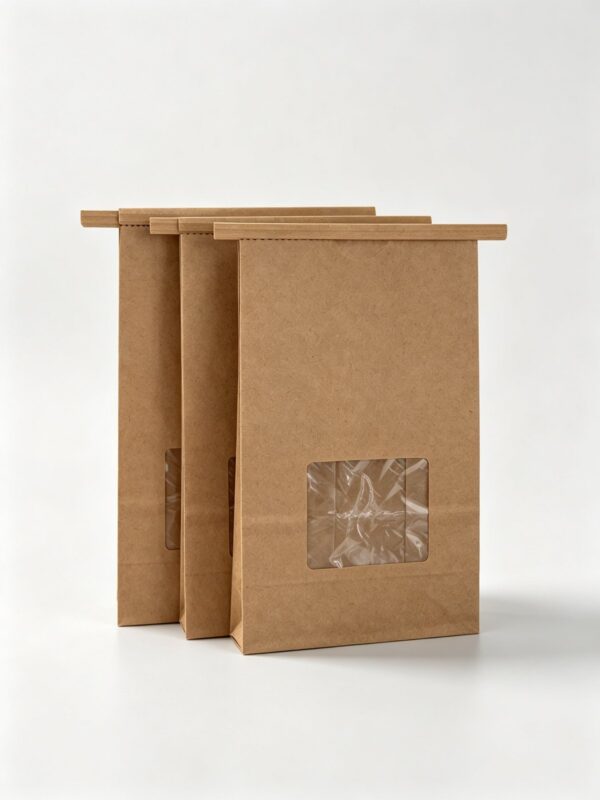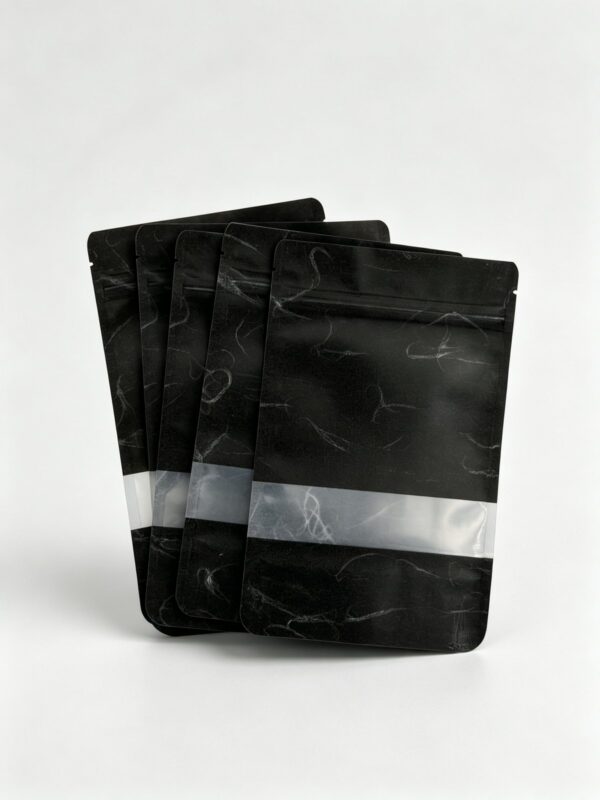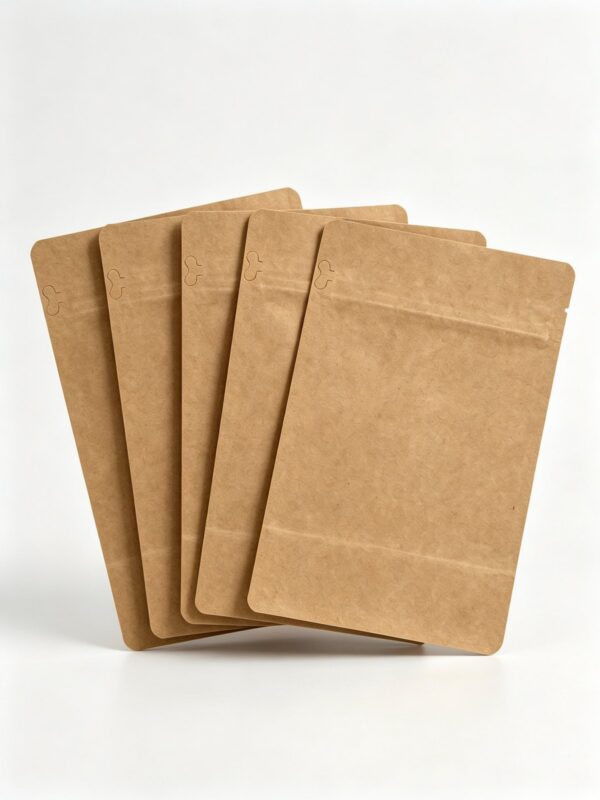
Kraft paper pouches are laminated pouches with a kraft paper outer layer bonded to an inner plastic or foil layer that provides the seal and the barrier. They give coffee, tea, bakery and dry goods a natural, handcrafted look while protecting the product like a conventional pouch. They are not paper-only packaging, however, and most kraft laminates are not easily recyclable, so they should be chosen for the right reasons.
What kraft paper pouches really are
Paper alone cannot be heat sealed, and it lets moisture, oxygen and grease straight through. To work as a food pouch, kraft paper is therefore laminated to functional layers. The paper supplies the look, the stiffness and the printable surface; the inner layers do the protective work.
| Structure | Barrier level | Typical products | Notes |
|---|---|---|---|
| Kraft/PE | Basic moisture protection | Bakery, dry snacks, short shelf-life goods, non-food items | Simplest and most economical; works well with windows |
| Kraft with a PET/PE inner laminate | Moderate | Tea, nuts, granola, dried fruit, pet treats | Better strength and sealing; good all-round choice |
| Kraft/AL/PE | High barrier to light, oxygen and moisture | Roasted coffee, powders, aromatic or oily products | Foil lining; not compatible with a clear window over the foil area |
Both natural brown and white kraft are common. Brown has the familiar rustic character; white gives cleaner, truer print colors.
Where kraft pouches shine
- Coffee. A foil-lined kraft flat-bottom coffee bag with a one-way valve combines a roastery look with the barrier that roasted beans need.
- Tea and herbs. Kraft stand-up zipper pouches reseal easily and stand well on the shelf.
- Bakery and confectionery. Kraft window tin-tie bags suit cookies, bread and granola sold fresh.
- Dry goods. Grains, pulses, nuts, spices and pet treats, especially for organic, natural or artisan brands.
Kraft is less suitable for liquids, for retort or boiling applications, and for wet or frozen environments where the exposed paper face can absorb water and scuff. For larger, heavier fills, kraft flat-bottom pouches give the most stable base and five printable panels.
Window options
A window is made by die-cutting an opening in the paper layer so that the clear inner film shows through. Common choices are a vertical strip, an oval or rectangle, or a custom shape that matches the brand. Kraft window stand-up pouches let shoppers see the product’s color and texture, which helps granola, tea blends, pasta and candy.
Two trade-offs apply. The window area has only the barrier of the clear film, with no protection from light. It also cannot sit over a foil lining, so foil-lined bags are normally windowless. If your product is sensitive to light, keep the window small or leave it out.
Printing on kraft
Kraft is printed on its outer surface, not reverse printed like plastic laminates, and the paper changes how ink behaves:
- Colors look warmer and more muted on brown kraft, because the inks are partly transparent. Bright colors need a white ink underlay or white kraft.
- Very fine detail softens. Paper fibers are rougher than film, so avoid tiny reversed text and hairlines.
- Simple designs work best. One to three colors, bold type and generous unprinted paper usually look better than full-coverage photographs, and need fewer cylinders.
- Surface ink is exposed. Ask about a protective varnish if the bags will rub together in transit.
- Proof on the real substrate. A Pantone color on screen will not match the same ink on brown paper.
Sustainability: an honest look
Kraft paper comes from renewable wood fiber and looks natural. That is a genuine point in its favor, but it does not make a kraft pouch automatically the greener option. It is worth separating what is true from what is only implied by appearance.
What is and is not easily recyclable
A kraft laminate is a composite. Paper bonded to PE, PET or aluminum foil cannot be separated easily, so most paper mills and most plastic recyclers do not want it, and in most places it ends up in general waste. Some markets accept paper-based laminates in the paper stream under certain conditions, but the rules differ by country, so check the requirements where you sell. Kraft/AL/PE is the hardest of the three structures to recycle.
Nor is kraft the same as compostable. The plastic or foil lining does not break down in a compost heap. Certified compostable films exist in the industry, but they require certification to a recognized standard, access to suitable composting facilities, and careful shelf-life testing. Do not assume any brown pouch is compostable, and do not print that claim without certificates for the exact structure.
Mono-material structures
Pouches made entirely from one polymer family, such as all-PE, are easier to recycle where flexible-film collection exists. They usually give up some stiffness, heat resistance or barrier compared with multi-material laminates, and they do not have a paper feel. Availability and suitability for your product should be confirmed with your supplier and tested with your own filling process.
Down-gauging
Often the simplest improvement is to use less material: a thinner sealant layer, one layer fewer, or a smaller bag that fits the fill properly. Flexible pouches already use little material per pack compared with rigid containers, and they ship flat. Right-sizing extends that advantage without any new claim to defend.
Ask for documentation, not labels
Words such as eco, green or natural have no fixed meaning, and regulators in many markets are looking more closely at environmental claims. As the brand owner, you are responsible for what is printed on your pack. Ask your supplier for:
- a specification showing every layer and its thickness;
- third-party test reports relevant to your market, such as food-contact testing;
- certificates for any specific claim, showing the certificate holder, scope and validity;
- a clear statement of what the supplier cannot confirm.
Ruixiong Packaging is ISO 9001 and ISO 14001 certified. ISO 14001 covers how a factory manages its environmental impact; it is not a recyclability or compostability claim for any product, and we do not present it as one.
FAQ
Are kraft paper pouches recyclable?
Most are not easily recyclable, because the paper is bonded to plastic or foil. Local rules vary, so check the guidance for your market before you put any recycling claim on the pack.
Do kraft pouches keep coffee fresh?
With a foil lining and a one-way valve they offer a high barrier, comparable to other foil laminates. Kraft/PE alone is not suitable for roasted coffee that needs a long shelf life.
Can I print full-color artwork on kraft?
Yes, but colors shift on brown paper. Use a white underlay or white kraft for brand-critical colors, and approve a proof on the real material.
Ruixiong produces the full paper and eco packaging range in house, from printing to bag making. Tell us your product and target market and we will recommend a structure, explain plainly what can and cannot be claimed for it, and arrange samples: contact our team.