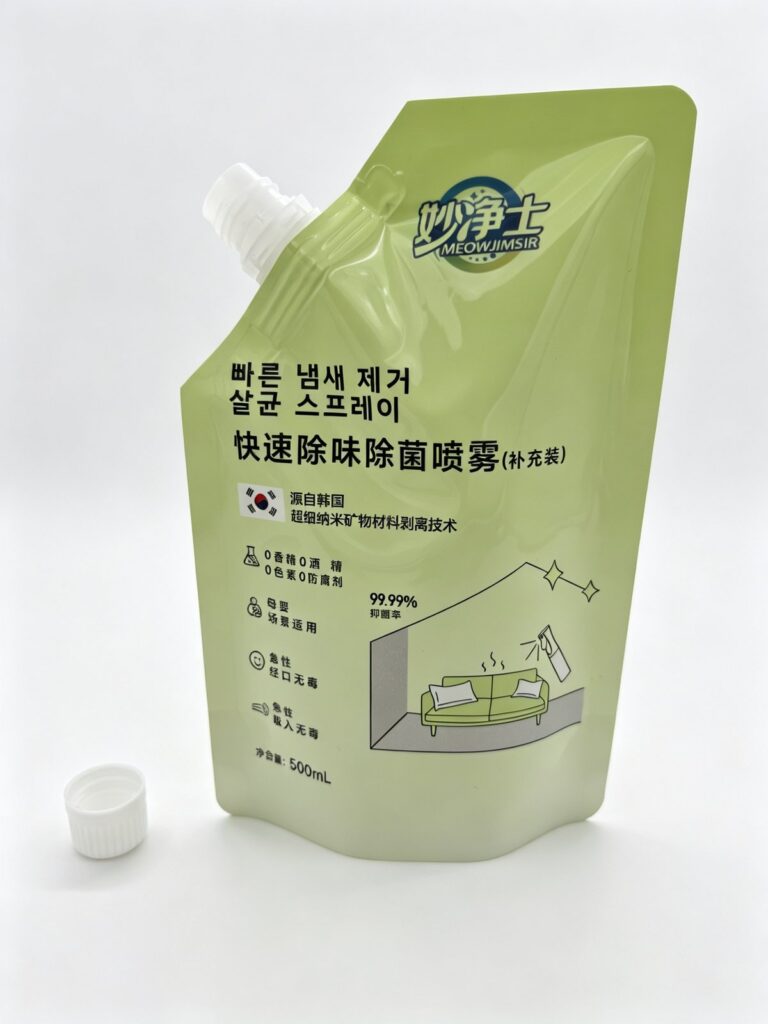
Spout pouches are flexible stand-up pouches with a welded plastic spout and a screw cap, made for liquids and pastes. For many refill, sauce, beverage and personal-care products they replace a rigid bottle with a lighter pack that ships flat before filling and prints over its whole surface. This guide explains where spout pouches make sense, where they do not, and what to specify when you ask for a quote.
What is a spout pouch?
A spout pouch starts as a laminated stand-up pouch: two printed panels and a bottom gusset that opens when the pouch is filled, so it stands on a shelf. A molded spout, often called a fitment, is heat-welded into the top edge or a corner and closed with a threaded cap.
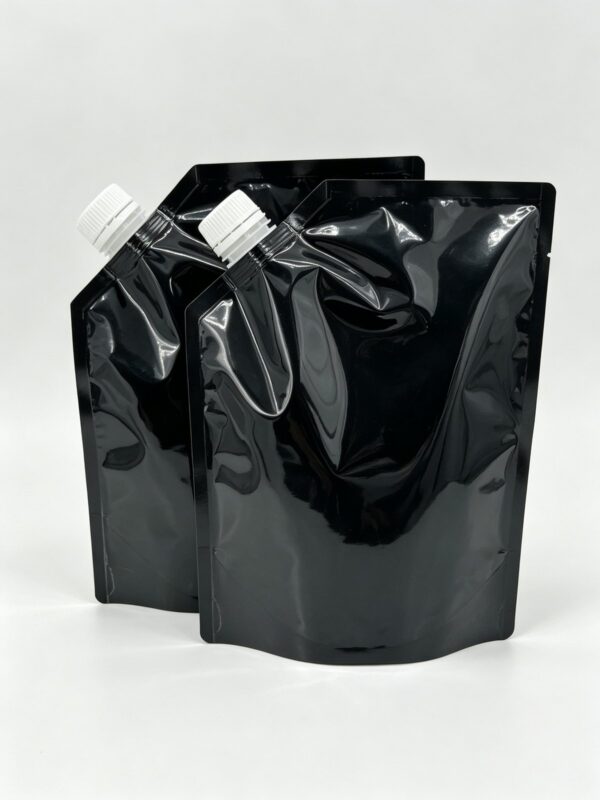
The pouch body does the barrier and branding work; the spout and cap control dispensing and reclosing. Ruixiong’s spout pouch range covers printed, metallized and clear-film versions.
Spout pouches vs bottles: where each one wins
Where the pouch wins
- Weight: a pouch uses far less material than a rigid bottle of the same volume.
- Freight and storage: empty pouches ship and store flat, while empty bottles are mostly air.
- Shelf impact: the whole front and back are printable, with no separate label, and a soft pouch can be squeezed until nearly empty.
Where a bottle is still the better choice
- Filling lines: bottle lines are widespread and fast; pouch filling needs dedicated equipment or a co-packer that has it.
- Recycling: multi-layer laminates are not easily recyclable in most systems, while many single-material bottles are. If recyclability is a requirement, ask about mono-material options and confirm availability and barrier with the supplier.
- Difficult products: carbonated drinks, strongly solvent-based products and products dosed with a pump are generally better in a bottle.
| Criterion | Spout pouch | Rigid bottle |
|---|---|---|
| Shipping empty packs | Flat, in compact cartons | Bulky |
| Print area | Full surface, no label needed | Label or sleeve |
| Recyclability | Limited for multi-layer laminates | Often easier for single-material bottles |
Spout and cap options
Center spout or corner spout
A center spout sits in the middle of the top seal. It suits drinking or squeezing straight from the pouch and is common on beverage, jelly and puree packs. A corner spout is welded at an angle into one top corner. It pours like a jug and is the usual choice for detergent refills, sauces and larger volumes.
Spout diameter
Narrow spouts suit thin liquids and drinking. Wider spouts are needed for thick sauces, products with particles and faster filling through the spout. Tell your supplier the viscosity and whether the product contains pieces, and ask which spout sizes are available.
Caps
The standard closure is a screw cap with a tamper-evident ring. For products that children may handle, ask about anti-choke caps. For household chemicals, ask whether a child-resistant closure is available and what documentation comes with it. These are options to confirm with the supplier, not features to assume.
Laminate structures for liquids
Liquids stress a pouch more than dry goods do: the contents are heavy and find any weak point in a seal. That is why liquid pouches normally include nylon (NY) for puncture and drop resistance, plus a thicker PE sealant layer.
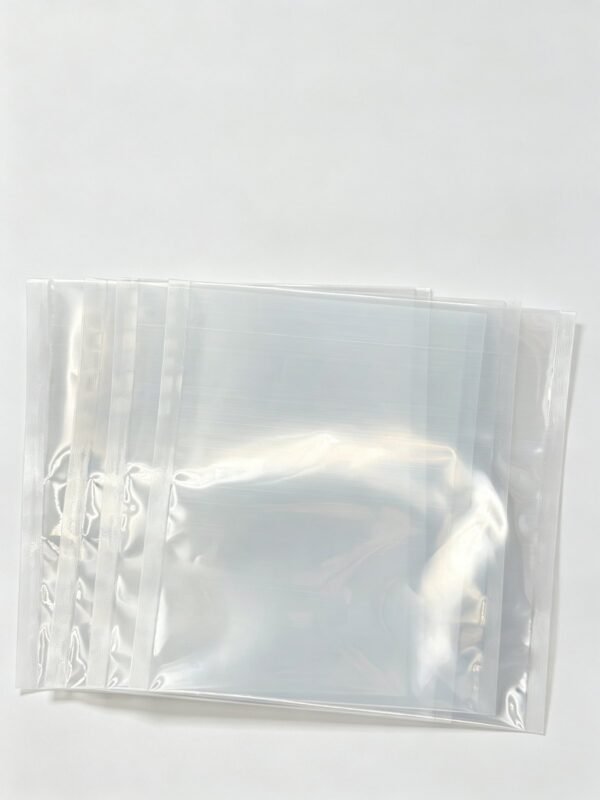
- PET/NY/PE: the workhorse structure for liquids. PET carries the print, nylon adds toughness and PE seals. It can be made clear.
- PET/AL/NY/PE: adds aluminum foil for a full barrier against light, oxygen and moisture. Used for light- or oxygen-sensitive contents.
- Metallized versions: a metallized film in place of foil gives a metallic look and good light protection at lower cost, as in our black metallized spout stand-up pouch.
If your product is hot-filled, pasteurized or retorted after sealing, say so at the start. Heat-resistant structures use different sealant films such as RCPP, and the spout and cap must tolerate the same temperature. Ruixiong produces retort pouches, but whether a spouted version suits your process has to be confirmed case by case.
Filling methods
Filling through the spout
The pouch arrives fully sealed with the spout in place. The filler holds the pouch by the spout, fills through it and then applies the cap. This method is clean and well suited to beverages and purees, but the spout diameter limits fill speed and particle size.
Top-fill, then seal
The pouch is supplied with the spout welded and capped, but with part of the top or side left open. Product goes in through the opening, which is then heat-sealed. This suits thick products, small producers with simple equipment, and hand filling. Tell the supplier which method you use, because it changes how the pouch is made.
Leak and drop testing: what to request
No buyer should approve a liquid pouch on looks alone. Results depend on the size, structure and product, so ask for:
- A leak or pressure test on the finished pouch, with attention to the weld between spout and film, the most common leak point.
- A drop test of filled pouches from a height that reflects your own handling and shipping.
- A compatibility check with your actual product, since surfactants, oils, acids and fragrances can attack inks, adhesives or the sealant.
- Third-party reports where they apply, such as food-contact testing of the film.
Typical products
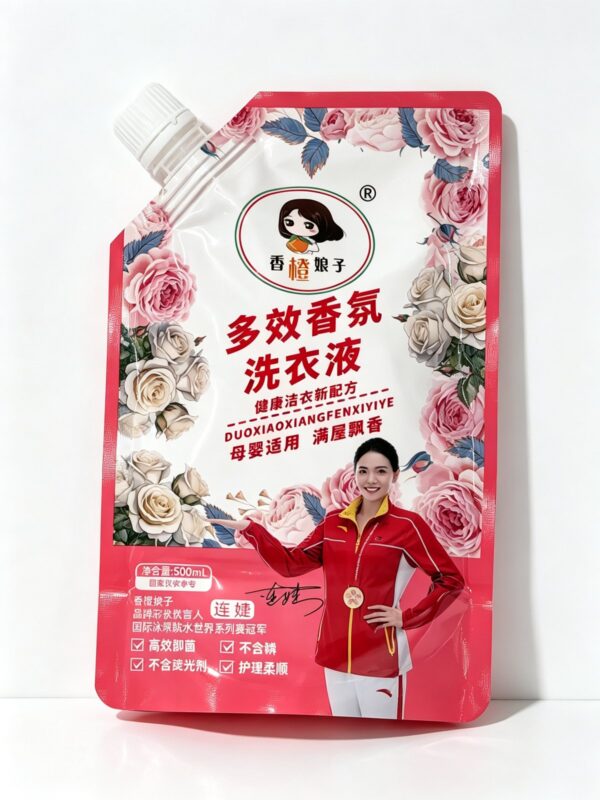
- Detergent and household refills: the printed stand-up spout pouch for laundry liquid pairs a screw spout with a stretch-resistant, chemical-resistant laminate.
- Sauces and beverages: dressings, syrups and cooking pastes, usually with a wider spout; juices and drinkable jellies, usually with a center spout.
- Cosmetics and personal care: shampoo, lotion and refill packs. See the printed stand-up spout pouch, available in clear, matte or metallized films.
- Baby and children’s food: fruit and vegetable purees are widely sold in center-spout pouches. The category is strictly regulated in most markets, so verify food-contact documents, cap design and any heat process with your supplier and your own regulatory advisor.
Printing
Spout pouches are reverse-printed on the PET layer before lamination, so the ink is sealed inside the laminate. Ruixiong prints by rotogravure in 1 to 10 colors, with printing, laminating and bag-making done in-house at our Dongguan factory. Keep key text and barcodes away from the spout weld and the bottom gusset. Digital or physical proofs are available before production.
FAQ
Can spout pouches take hot-filled or retorted products?
Some can, but only when the laminate, spout and cap are all specified for that temperature. Ask the supplier to confirm suitability with samples.
How long will a liquid keep in a spout pouch?
It depends on the product, the laminate barrier, filling conditions and storage, so confirm it with your own storage tests rather than relying on the material alone.
Can I test a small quantity before a full order?
Yes. Ruixiong handles small-batch sampling as well as volume orders. Fill the samples with your real product, then run leak, drop and transit checks before approving production.
Send us your fill volume, product type, filling method and spout position, and we will propose a structure, spout and print plan with a quote. Contact Ruixiong Packaging to start your spout pouch project.