Coffee bags with valve solve a specific problem: freshly roasted coffee releases carbon dioxide for days after roasting, and a sealed bag without a vent will swell or burst. A one-way degassing valve lets that gas out while keeping oxygen from getting in, so you can pack soon after roasting and still protect aroma. This guide covers how the valve works and how to choose the bag format, material, closure and print.
Why roasted coffee needs a valve
Roasting creates carbon dioxide inside the bean, and the gas escapes gradually afterwards. The release is fastest in the first days and then slows. Ground coffee degasses much faster than whole beans because the gas has a shorter way out.
Without a valve, a roaster has two poor options. Seal the coffee right away and the bag inflates, stresses its seals and may split in transit. Or leave the coffee to rest in open air before packing, which exposes it to oxygen, the main cause of stale flavor. A valve removes the trade-off: the coffee is sealed into a barrier bag promptly, and the bag vents itself.
How a one-way degassing valve works
The valve is a small plastic housing, usually with a flexible membrane or disc inside, heat-welded to the inner face of the bag over a few small punched holes.
- When pressure inside the bag rises above the outside pressure by a small margin, the membrane lifts and carbon dioxide escapes.
- When the pressure evens out, the membrane settles back onto its seat and closes the path, so outside air cannot flow in.
Two practical points. First, the valve is normally placed on the upper part of the front or back panel, above the fill line, so beans do not press against it. Second, a valve does not add barrier. It only manages pressure. Protection from oxygen, moisture and light still depends on the laminate and on good seals. For ground coffee, ask for a valve with a filter so fine particles do not clog the membrane.
Bag formats for coffee bags with valve
Flat-bottom kraft bag
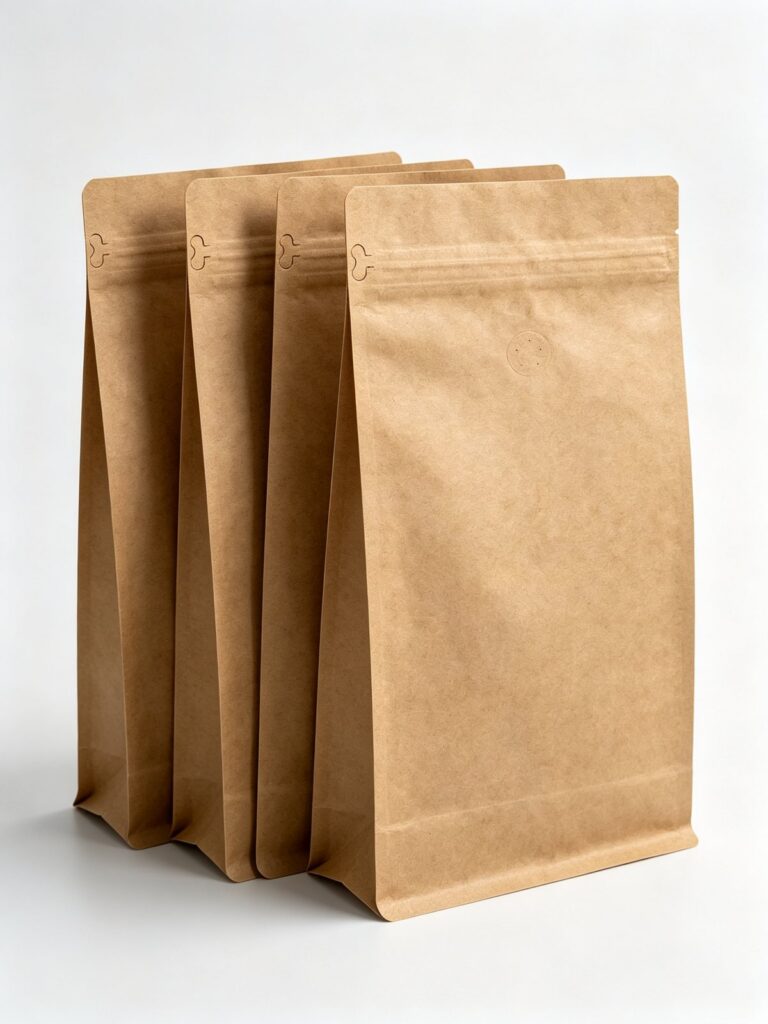
The box-shaped bag that many specialty roasters use for retail. It stands square, gives five printable panels and opens wide for filling. The kraft flat-bottom coffee bag with one-way valve pairs a natural kraft face with a high-barrier foil laminate inside, so the rustic look does not mean giving up barrier.
Quad-seal foil bag
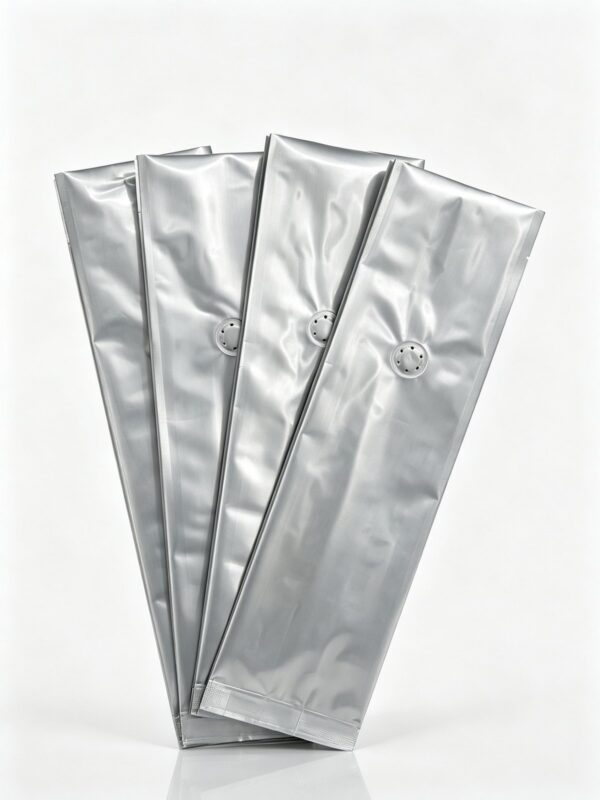
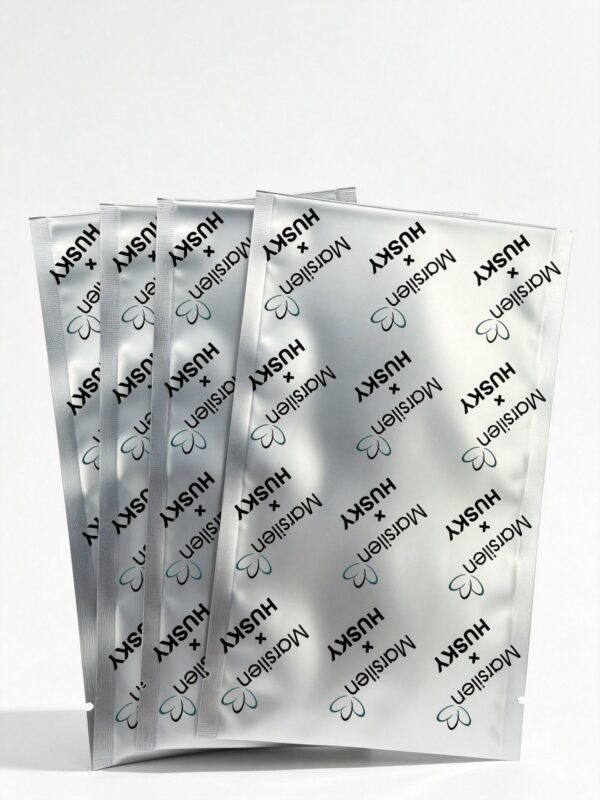
The classic coffee bag: side gussets and four sealed corners that give a firm, pillar-like shape. It handles larger and heavier fills well and is usually closed by heat seal, often with a tin-tie for reclosing. The pure foil quad-seal coffee bag offers full light, oxygen and moisture blocking and strong aroma retention.
Stand-up pouch
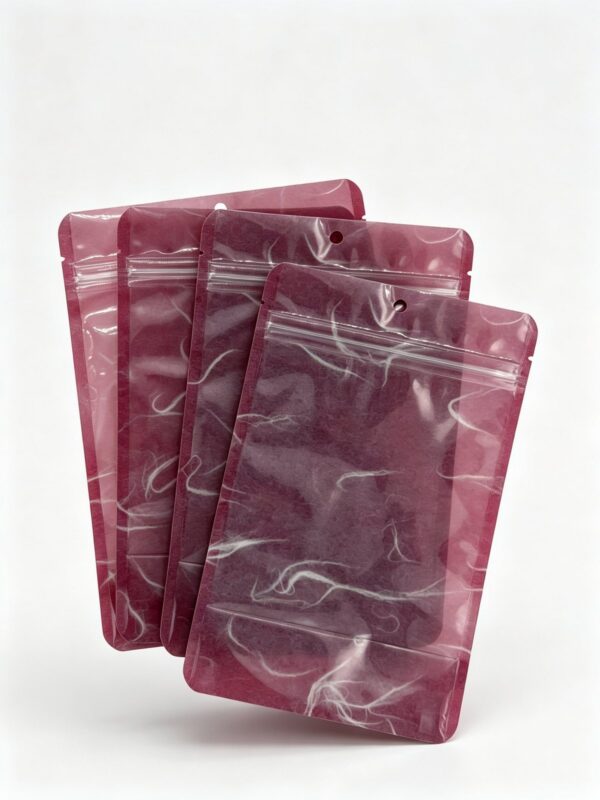
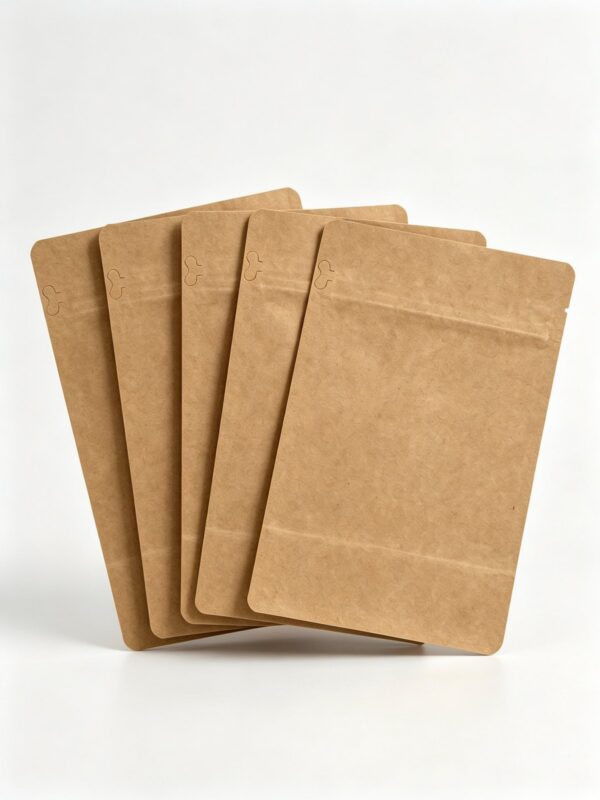
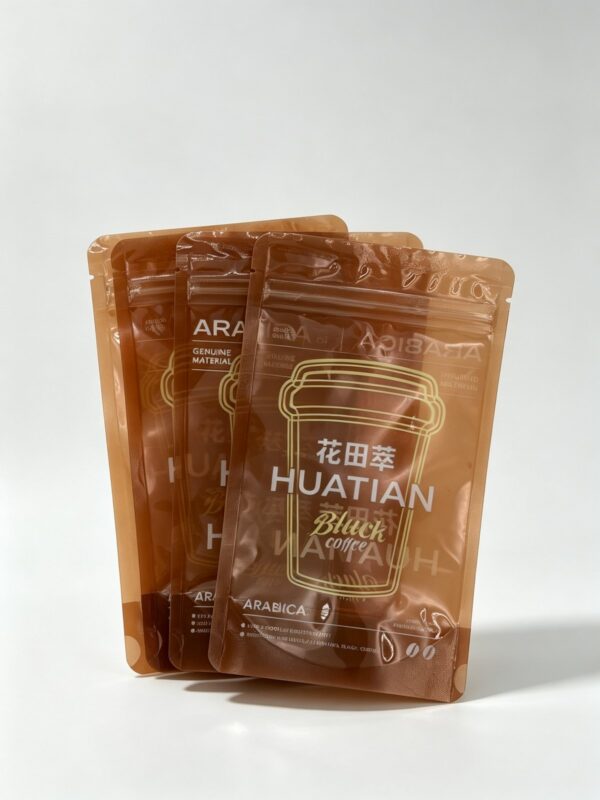
A bottom-gusset pouch with a zipper is the economical choice for smaller packs, samples, and ranges with many origins or blends where packaging cost per SKU matters. It can be made in film or as a kraft stand-up zipper pouch, with or without a valve.
Kraft window tin-tie bag
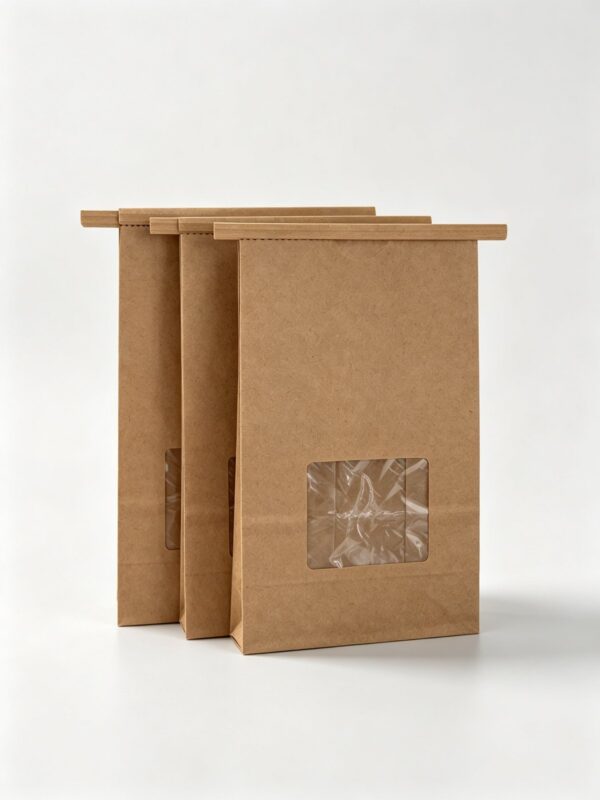
A paper-look bag with a clear window and a fold-down wire closure, common on cafe counters and in bakeries. The kraft window tin-tie stand-up bag shows the beans and is quick to fill and close by hand. Its barrier is basic and the window admits light, so it suits coffee that is sold and consumed soon after roasting.
| Format | Barrier level | Reclose | Best for |
|---|---|---|---|
| Kraft flat-bottom with foil liner | High | Zipper or pocket zipper | Retail bags for specialty coffee, premium positioning |
| Pure foil quad-seal | High | Tin-tie or heat seal only | Larger fills, wholesale and food-service packs |
| Stand-up zipper pouch | Basic to high, depending on laminate | Zipper | Small packs, samples, wide product ranges |
| Kraft window tin-tie | Basic | Tin-tie | Counter sales and fast local turnover |
Materials for coffee bags
Coffee is sensitive to oxygen, moisture and light, and its aroma compounds escape through weak films. Common structures are:
- PET/AL/PE: pure aluminum foil in the middle. The highest barrier and the usual choice for coffee that ships far or sits in distribution.
- Kraft/AL/PE: the same foil barrier behind a kraft paper face.
- PET/VMPET/PE: metallized film. A good barrier at lower cost, suitable for faster-moving coffee.
- Kraft/PE: paper look with basic moisture protection only; for short sales cycles.
Whatever the structure, do not promise a shelf life from the material alone. It depends on the coffee, the roast, residual oxygen at sealing and storage conditions, so confirm it with your own tests.
Zipper or tin-tie?
Zippers give the most convenient and tightest reclose. Press-to-close zippers are standard on stand-up pouches; flat-bottom bags often use a pocket zipper opened by a tear strip on the front panel. A heat seal above the zipper with a tear notch provides tamper evidence.
Tin-ties are a wire strip the consumer folds down after rolling the top of the bag. They are simple, work well with quad-seal and paper bags, and suit hand packing. The reclose is less airtight than a zipper, which matters less for coffee that is used up quickly.
Choosing a bag size
Coffee bags are sized by volume, not only by weight. Whole beans take more space than the same weight of ground coffee, and dark roasts are less dense than light roasts, so the same weight can need a larger bag. Small sample packs often use a simple three-side-seal or small stand-up pouch. Standard retail sizes suit stand-up and flat-bottom bags with a valve. Large wholesale bags are usually quad-seal or flat-bottom with a heavier laminate and wider seals. Always test-fill samples with your own coffee and leave enough headspace to seal cleanly.
Printing on kraft paper
Kraft is brown, slightly absorbent and textured, and that changes how artwork behaves:
- Colors print darker and more muted than on white or clear film. Bright colors usually need a white ink layer underneath.
- Very fine lines, small reversed-out text and subtle gradients lose sharpness. Bold shapes and solid colors work best.
- The paper shade varies slightly between lots, so expect small differences from run to run.
Ruixiong prints by rotogravure in 1 to 10 colors, with printing, laminating and bag-making done in-house at our Dongguan factory. For kraft designs, we recommend approving a physical proof rather than relying only on a screen.
FAQ
Does every coffee bag need a valve?
No. Whole-bean and ground coffee packed soon after roasting benefit most. Coffee that has already rested, instant coffee and small single-serve sachets are often packed without one.
Does the valve let air into the bag?
A properly working valve opens only outward. It does not improve the barrier of the film, though, so a good laminate and sound seals still matter.
Are kraft coffee bags recyclable?
A kraft face laminated to foil and PE is a multi-material structure and is not easily recyclable in most systems. If recyclability is a requirement, ask your supplier about mono-material options and confirm the barrier is sufficient for your coffee.
Ruixiong handles small-batch sampling as well as volume orders. Tell us your fill weight, whole bean or ground, and the look you want, and we will propose a format, laminate and valve position with a quote. Contact Ruixiong Packaging to get started.